
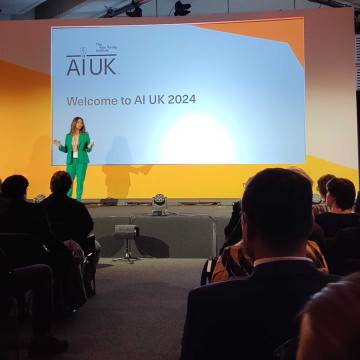
It was a fantastic opportunity to attend this year's AI UK conference at the Queen Elizabeth II conference centre. There were so many discussions, exhibitions, and visions for the future of artificial intelligence. The conference underscored the gap between those with access to technology and those without, a divide that threatens to leave many voices unheard in AI training. There were some thought-provoking sessions and exhibitions.
These are the potential paths AI might take in the coming years.
Day 1
The New Real: Opening Provocations
"Artistic and Queer Visions of AI Futures" Most refreshingly the session kicked off with a bang; we were delighted by speakers from the creative industries who have been making AI work for them.
- An AI drag queen trained by a real drag queen,
- A robotic arm and trained to paint by an artist.
The speakers challenged us to rethink our understanding of AI's mistakes—are they mere errors, or could they be considered new creations? This session pushed the boundaries of our conventional perspectives on AI's role in creativity and society.
Putting LLMs to Work
A session dedicated to "Putting LLMs to Work" posed critical questions about the utility and challenges of generative AI. For example, it is now super easy to generate versions of scientific papers. All submitted papers are reviewed but what happens when the volume submitted becomes untenable?
People worry that AI replace them. Maybe, but the amount of legal challenges that AI is bound to spin up will keep lawyers busy; unless they start using large language models!
We laughed at the idea of AI replying to our emails and the recipient AI continuing the conversation back again; much like AI email ping pong!
Data, Labour, and AI
The conference also tackled the ethical considerations of AI development, particularly the exploitation of gig workers in training LLMs to filter harmful data. Mophat Okinyi spoke to us from Kenya giving us a brief insight into the harms that have been done to teleworkers working for companies training LLMs on social media data.
Just imagine having to look at all of the most distressing and offensive content every day for hours upon hours!
This session illuminated the critical role of these workers, who possess an intimate understanding of the business far beyond that of many CEOs.
Exhibition Stands
There are already some amazing innovations being created.
University of Exeter
Really interesting to see that AI understands images in a much different way than we do. For example, whereas we concentrate on the head of an animal, the AI judges the image quite differently. In this example, the chicken in the middle picture has some very light pixellation around its head and the AI labelled it as a fox. In the picture on the right, the middle area of the man is pixellated so the AI was unable to recognise him.
The children were invited to be the interviewers, posing their questions and giving their opinions. They were very concerned that AI should be fair, that all children should be offered the same advantages. Most interestingly was their response to the proposal to train AI on video of children so that it could be used to predict seizures. The children were very clear; they did not wan their data to be stored. This influenced the project and work to further anonymise the data is being undertaken. Overall there was a big emphasis on making AI safe.